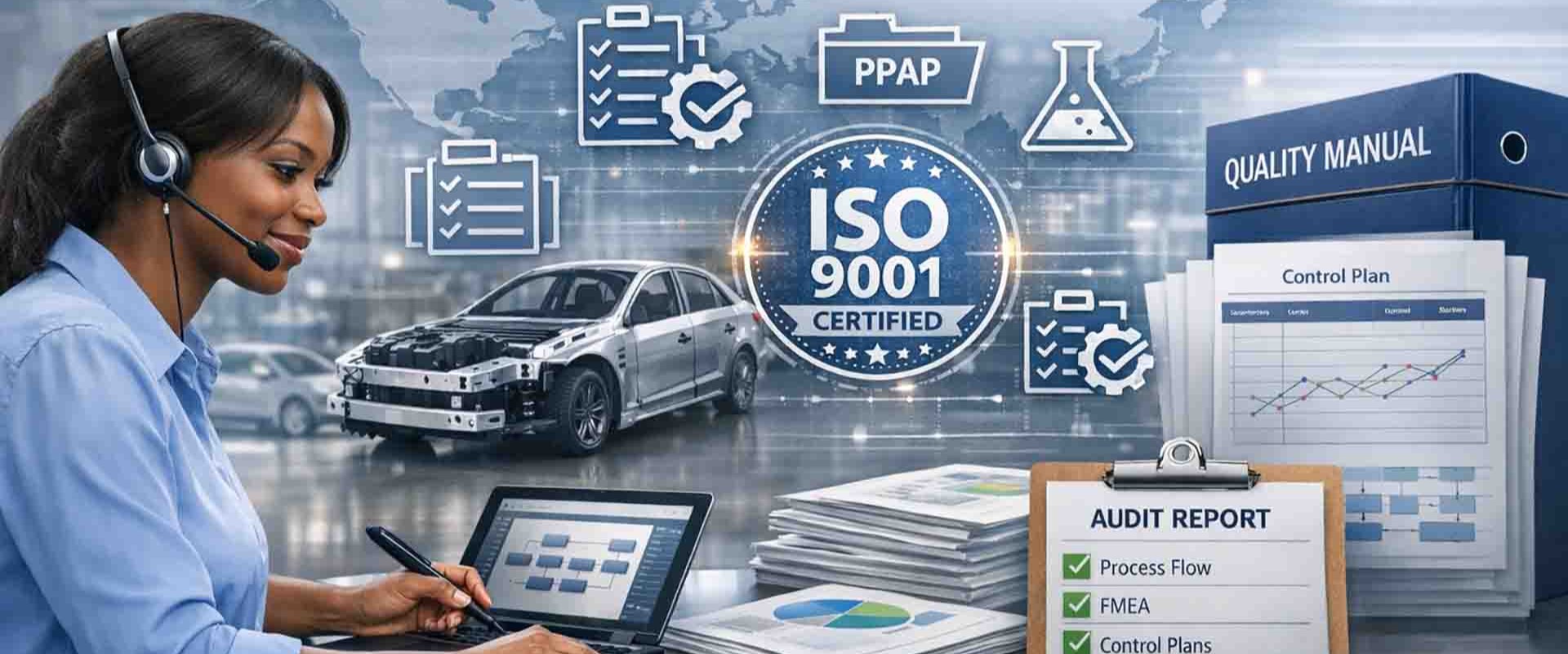
Category Compliance Meets Clarity

PPAP and PPF

Why PPAP & PPF Matter More Than Ever in Modern Manufacturing

If you work in manufacturing, automotive, or supply chain management, you’ve probably heard the terms PPAP and PPF more times than you can count. But for many companies, these processes still feel overly complicated, time-consuming, or just plain stressful.

The truth? They don’t have to be.

At their core, PPAP (Production Part Approval Process) and PPF (Production Process and Product Release) are all about one thing: making sure your parts and processes meet customer requirements—before production problems happen.

And that’s exactly where we come in.

What is PPAP?

PPAP is a standardized process used to prove that a supplier understands all customer requirements and can consistently deliver quality parts.

In simple terms, it answers the question:

“Can you reliably produce this part exactly as required?”

PPAP usually includes:

  • design records
  • process flow diagrams
  • FMEAs
  • control plans
  • measurement reports
  • capability studies
  • sample approvals

Sounds like a lot—and it is. But done correctly, it saves time, money, and headaches later.

What is PPF?

PPF is the German equivalent often used in the automotive industry, especially with OEMs and suppliers in Europe.

It follows the same goal:
validate your production process and approve your product for serial production.

If your business works with German manufacturers or suppliers, PPF is often a mandatory step.

Why Your Business Needs PPAP & PPF Support

Let’s be honest: documentation can slow teams down.

Your engineers want to build.
Your production team wants to manufacture.
Your customer wants parts delivered on time.

Nobody wants delays because of missing paperwork.

That’s why outsourcing or getting expert support makes sense.

With professional PPAP and PPF services, you can:

Save Time

No more struggling through templates or figuring out customer requirements alone.

Avoid Costly Mistakes

A missed document or incorrect approval can delay an entire project.

Improve Customer Confidence

A clean, complete submission shows professionalism—and builds trust.

Stay Compliant

Automotive and industrial customers expect high standards. We help you meet them.

Our PPAP & PPF Services

We support companies with:

  • complete PPAP preparation
  • PPF documentation packages
  • FMEA and Control Plan creation
  • process documentation
  • customer-specific requirements
  • submission reviews
  • gap analysis
  • training and consulting

Whether you need full support or just help with one section, we adapt to your project.

Who We Work With

Our services are ideal for:

  • automotive suppliers
  • manufacturers
  • startups entering OEM supply chains
  • quality departments
  • project managers
  • international suppliers

No matter your company size, we help simplify the approval process.

Let’s Make Approval Easy

PPAP and PPF shouldn’t slow your business down—they should support growth.

Our goal is simple:
make your approval process faster, smoother, and stress-free.

Need support with your next PPAP or PPF submission?
We’re ready to help.

Employee Training

Employee training is a critical success factor for organizations aiming to meet and sustain the requirements of the ISO 9001 standard established by the International Organization for Standardization. The standard emphasizes not only the documentation of processes within a Quality Management System (QMS), but also the ability of employees to understand and correctly apply those processes in their daily work.

A core requirement of ISO 9001 is employee competence. Organizations must ensure that their staff possess the necessary skills, knowledge, and experience to perform their tasks effectively and in line with quality standards. Without structured training programs, this requirement is difficult to achieve. Training ensures that employees clearly understand procedures, responsibilities, and quality objectives, reducing the likelihood of errors and inconsistencies.

Furthermore, training strengthens quality awareness across the organization. ISO 9001 explicitly requires that employees understand the company’s quality policy and their individual contribution to achieving quality objectives. Well-designed training programs foster this understanding by explaining the purpose behind processes, identifying potential risks, and demonstrating how each employee contributes to customer satisfaction.

Another important benefit of employee training is error prevention. Well-trained employees are better equipped to identify potential issues early and take proactive measures. This reduces costs associated with rework, defects, and customer complaints, while improving overall operational efficiency. In a system that focuses on continuous improvement, such as ISO 9001, this proactive mindset is essential.

Training also enhances an organization’s ability to adapt to change. Standards, technologies, and market conditions are constantly evolving. Continuous training ensures that employees stay up to date and are capable of implementing changes effectively within the Quality Management System.

Additionally, documenting training activities is a key requirement of ISO 9001. Organizations must be able to demonstrate employee competence through records of education, training, and experience. A structured training program simplifies this documentation and provides transparency during internal and external audits.

In conclusion, employee training is not an optional activity but a fundamental requirement for achieving and maintaining ISO 9001 compliance. It bridges the gap between documented procedures and real-world execution, strengthens a culture of quality, and supports continuous improvement. Organizations that invest in their employees’ development build a strong foundation for long-term success and sustained compliance with the standard.

APQP

What Is APQP?

APQP (Advanced Product Quality Planning) is a structured framework used in the automotive industry to ensure that products meet customer expectations from concept to production. It is a core requirement of IATF 16949 and supports suppliers in launching products right the first time.

The 5 Phases of APQP

🔹 1. Plan & Define Program

  • Customer requirements
  • Project goals
  • Risk assessment

🔹 2. Product Design & Development

  • Design FMEA
  • Design reviews
  • Validation of specifications

🔹 3. Process Design & Development

  • Process Flow Diagram
  • PFMEA
  • Control Plan
  • Work instructions

🔹 4. Product & Process Validation

  • Production trial runs
  • PPAP submission
  • Capability studies

🔹 5. Feedback & Continuous Improvement

  • Monitoring production
  • Lessons learned
  • Ongoing optimization

APQP Tools We Support

Process Flow Diagrams

Clear visualization of manufacturing steps.

PFMEA

Risk analysis to prevent failures before they occur.

Control Plans

Defined controls for stable, repeatable processes.

MSA

Verification of measurement system capability.

SPC

Statistical monitoring of process performance.

PPAP

Complete documentation package for customer approval.

Why APQP Matters

  • Ensures first‑time quality
  • Reduces delays, rework, and non‑conformities
  • Aligns with IATF 16949 & ISO 9001
  • Supports smooth product launches
  • Strengthens customer confidence

IMDS Management

We support suppliers in the automotive industry with fully compliant, audit‑ready IMDS submissions. With more than a decade of experience in quality management and automotive requirements, we ensure that your material data reporting is accurate, complete, and aligned with OEM expectations.

Our approach is simple: We translate complex IMDS rules into clear, correct, and efficient submissions that integrate seamlessly into your existing processes.

What We Deliver

  • Complete IMDS data entry and submission
  • Review and correction of existing IMDS entries
  • Compliance checks according to GADSL, REACH, and OEM-specific requirements
  • Structure and validation of material data sheets (MDS)
  • Support for supplier cascades and data requests
  • Guidance for PPAP‑relevant IMDS documentation
  • Ongoing maintenance for part updates and engineering changes

Every submission is created with a strong focus on accuracy, compliance, and usability, ensuring smooth approval by customers and OEMs.

Quality Documentation Service

Structured. Compliant. Audit‑Ready

At Kimani Industrial Services, we provide professional, audit‑ready documentation tailored to the requirements of ISO 9001 and IATF 16949. With more than a decade of experience in industrial quality management, we support companies in establishing clear, structured, and compliant documentation that strengthens their processes and ensures long‑term system stability.

Our approach is straightforward:
We translate complex standard requirements into practical, easy‑to‑use documents that fit seamlessly into your existing workflows.

What We Deliver

  • Complete Quality Management documentation
  • Process descriptions and process mapping
  • Work instructions and operational procedures
  • Templates, forms, and checklists
  • Risk and opportunity assessments
  • Internal audit documentation
  • Corrective action and non‑conformity records
  • IATF‑specific documents such as Control Plans, FMEAs, APQP elements, and more

Every document is created with a strong focus on clarity, usability, and full compliance with the latest standard revisions.

Why Companies Choose Us

  • Over 10 years of hands‑on industry experience
  • Tailor‑made documentation instead of generic templates
  • Reliable, efficient, and professional collaboration
  • Deep understanding of ISO and IATF requirements
  • Support from initial setup to certification readiness